Greek Art, Laocoon and His Sons Antiphas and Thymbraeus.
 |
| Laocoon and His Sons Antiphas and Thymbraeus. |
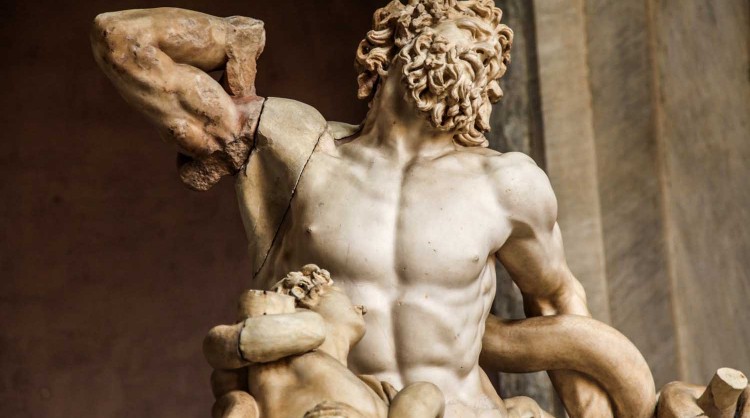
The Lacoon is a very popular marble sculpture that stands 8 feet high and is assumed to have been sculpted around 42-20 BCE. Another interesting thing to note is the uncertainty of whether this sculpture is an original Roman piece or if it is a copy of an earlier on Greek sculpture. If this is the case, it is hypothesized that its three sculptors Hagesander, Athenodoros, and Polydorus were all very skilled at copying Greek pieces for the wealthy Romans. With this theory in mind, it is probable that this piece is a copy of a bronze Hellenistic version. The story behind this sculpture explains how the Trojan priest Laocoon tried warning the Trojans about sneaking into the city of Troy for it might be a trap. In doing so, the Greek goddess Athena punished Laocoon in order to protect the Greeks, by sending two giant snakes after him and his two sons. As you can see one son breaks free from the grasp of the snakes while the other two perish. (http://www.visual-arts-cork.com/sculpture/laocoon.htm)
The Laocoon sculpture was discovered in a Rome vineyard in 1506. One expert that attended the excavation process was Michelangelo the famous painter and sculptor of his time. Once discovered it was brought to the Vatican and displayed in the courtyard. This sculpture became very famous overtime and was an inspiration for many artists who loved Greek art. Then in 1799, Napoleon removed the sculpture and moved it to the Louvre in Paris where it stayed until 1816 when it was returned to the Vatican after the defeat of Napoleon.
 |
http://www.visual-arts-cork.com/sculpture/laocoon.htm
Comments
Post a Comment